EHR Connectivity
EHR Integrations
FHIR R4-native integration with the EHR platforms your sites already use — from Epic and Oracle Health to Athenahealth and MEDITECH.
EHR systems with active integration support
Cohortbridge supports FHIR R4-based read access to the following EHR systems. Integration names are displayed as platform descriptors — Cohortbridge is not an official partner or certified integration of these vendors.
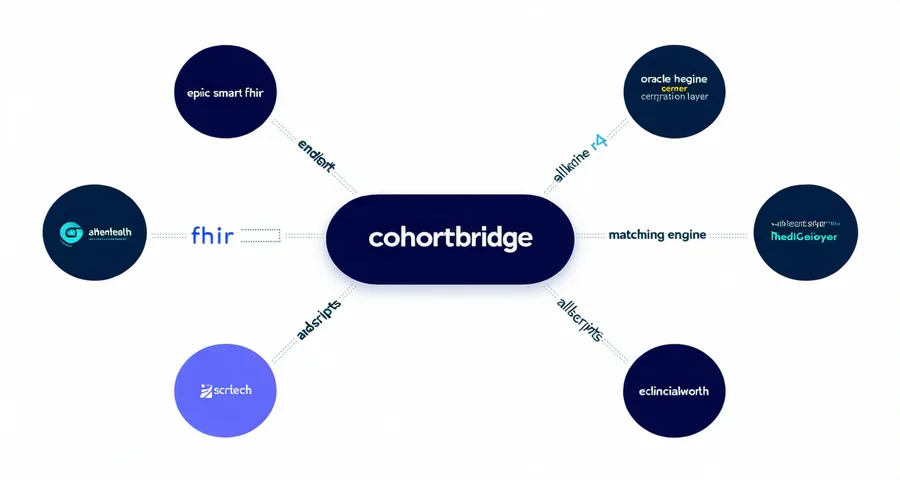
FHIR R4 as the integration foundation
Cohortbridge uses HL7 FHIR R4 as its primary integration standard. FHIR R4 is the current US interoperability baseline required by the 21st Century Cures Act for patient data access, making it the most widely supported API protocol across major EHR vendors.
FHIR R4 resources used by Cohortbridge for patient matching: Patient, Condition, Observation, MedicationRequest, Procedure, DiagnosticReport. Read-only access only.
SMART on FHIR authorization
Epic and other EHRs that support SMART on FHIR use OAuth 2.0-based authorization flows that scope data access to the minimum required population and fields. Cohortbridge's Epic integration is built on the SMART on FHIR framework.
FHIR API → Matching logic → De-identification
On-premise option for strict data residency requirements
Some health systems have contractual or policy requirements that patient data cannot leave their network — even for CRO-approved research queries. Cohortbridge supports these requirements through an on-premise deployment option.
The Cohortbridge matching agent is deployed within the health system's own infrastructure. All criteria matching and de-identification logic runs locally. Only de-identified cohort reference IDs and eligibility scores are transmitted to Cohortbridge infrastructure and the CRO team.
EHR integration timeline
EHR Access Agreement (2–6 weeks)
Execute data use agreement with the health system. Cohortbridge provides standard DUA templates. Timeline depends on the health system's legal and compliance review process. Academic medical centers with IRB oversight typically require 4–6 weeks; community health systems with existing research frameworks may move faster.
FHIR API Configuration (3–5 business days)
Technical setup of the FHIR R4 connection. Cohortbridge's technical team handles API endpoint configuration and OAuth 2.0 / SMART authorization setup. For Epic, this requires Epic MyChart application registration through the health system's Epic administrator.
Test Query Validation (1–2 business days)
Run test queries against a limited patient population with health system technical staff present to validate field mapping accuracy and confirm de-identification is functioning correctly before live protocol matching begins.
Live protocol matching
Once validated, the site is active in the Cohortbridge network. Future protocols at the same site can be matched without repeating the EHR access agreement or FHIR configuration steps.
Ready to start the EHR access process?
We provide standard DUA templates and technical documentation to help CROs and health systems move through EHR access agreements efficiently.