Clinical trial patient matching
Clinical trial enrollment starts with finding the right patients. Not reviewing 10,000 charts.
Cohortbridge connects CRO feasibility teams to eligible patient cohorts by running structured eligibility matching against EHR data — before the chart pull.
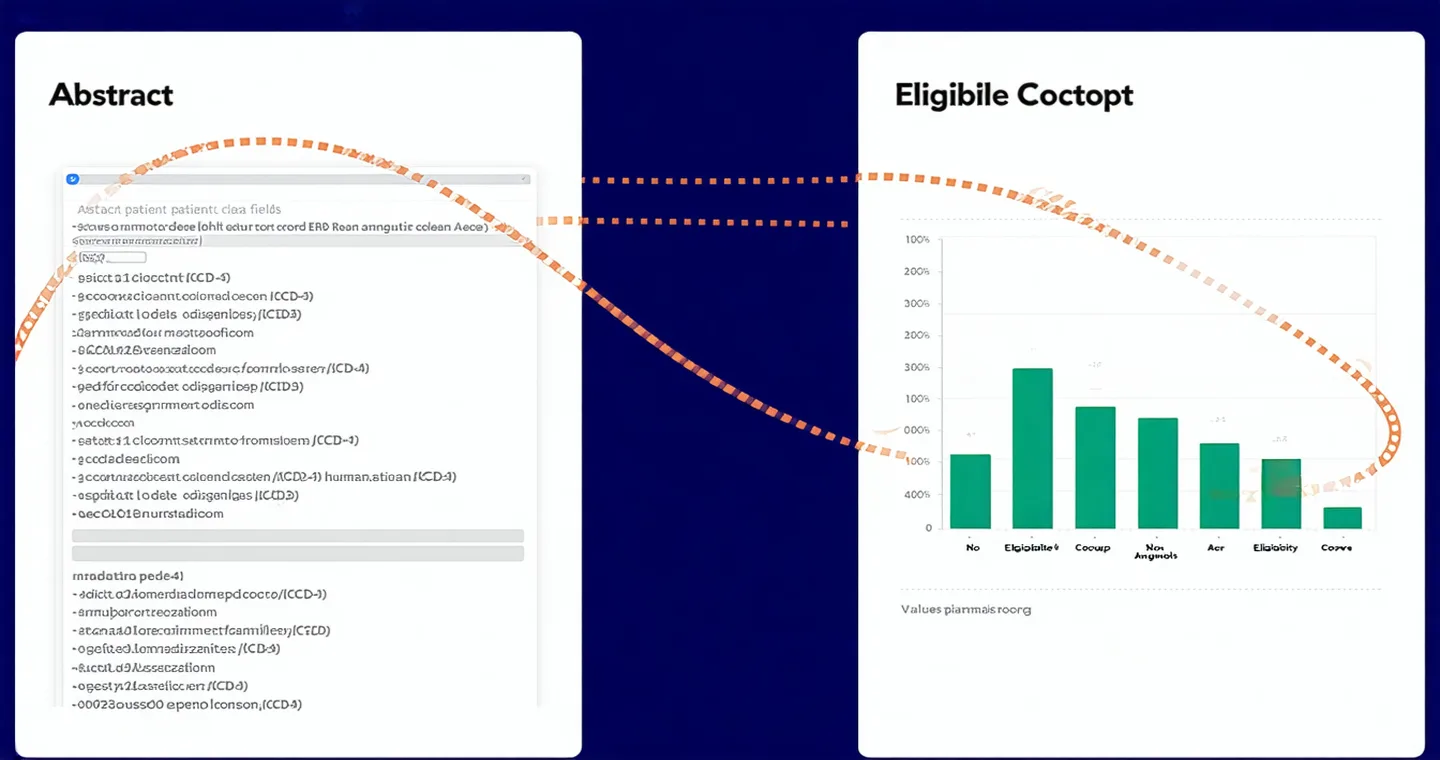
Manual chart review is where enrollment timelines go to die.
CROs routinely allocate 1–2 CRA days per site for feasibility assessments — most of that time is spent reviewing charts for patients who turn out not to be eligible. Phase II trials with a 200-patient enrollment target can spend 6–10 weeks just identifying an eligible cohort across 8–12 sites.
The selection criteria haven't changed. The EHR data has been structured for years. The matching logic is deterministic. Only the process is still manual.
The manual feasibility loop
From EHR data to eligible cohort in four steps
Cohortbridge parses your protocol's inclusion and exclusion criteria into structured logic, then runs those queries against de-identified patient records in connected EHR systems.
EHR Ingestion
FHIR R4 connection to Epic, Cerner, Athenahealth and more
Criteria Parsing
Protocol I/E criteria parsed into structured eligibility logic
Eligibility Engine
Matching logic runs against de-identified patient records
Ranked Cohort Output
Prioritized list with eligibility confidence scores delivered to your team
Measurable difference in feasibility timelines
not weeks
Metrics reflect directional outcomes from internal pilot programs with participating health system partners, not peer-reviewed benchmarks.
Purpose-built for mid-size CRO feasibility operations
Cohortbridge is not a patient recruitment campaign tool or a CRM. It's an eligibility matching platform designed for CRO operations teams running Phase II/III feasibility assessments — the teams who negotiate EHR access agreements, work with site coordinators, and deliver enrollment estimates to sponsors.
See how CROs use CohortbridgeFaster Feasibility
Identify eligible cohorts before site activation, not after weeks of chart review.
PHI-Respecting
De-identified cohort output. No patient names or MRNs in the matching results.
EHR-Native
FHIR R4 integration. Works with Epic, Cerner, and 10+ other EHR systems.
Sponsor-Ready
HIPAA safeguards designed-in. IRB-compatible data flow documentation available.
Patient data handling your IRB can document
CRO procurement teams — and their pharma sponsors — review data handling architecture before any feature evaluation. Cohortbridge is designed with HIPAA administrative, technical, and physical safeguards throughout the matching pipeline.
Patient EHR data is processed under applicable IRB-approved protocols at participating health systems. The matching output contains de-identified cohort references only.
Read our privacy architectureWhat CRO feasibility teams are saying
"Our site feasibility process was built around CRA time and historical enrollment estimates. Running Cohortbridge against Epic data before site selection gave us a concrete number — not a guess — for how many patients at each site actually met the inclusion criteria."
"For a rare disease oncology study, we had twelve sites and estimated 6–8 eligible patients per site based on historical data. The Cohortbridge cohort analysis identified only 2–3 per site but pointed to two sites with 10+ eligible patients we hadn't prioritized. That changed our enrollment plan before we activated a single site."
See a live patient-protocol eligibility run
We'll walk through a de-identified match run using your protocol's inclusion/exclusion criteria against a connected EHR dataset. No slide deck — actual matching output.